Every one of the sixty-four Black Belts of the Karate Institute of America
knows it. Every person who has become successful in any line of endeavor knows
it, and those individuals who want to survive the coronavirus pandemic, as
well as its aftermath, need to know it if they don’t already.
Do you know what “it” is? Luck? Good luck with that. Hope? A nice thought but
hope is just a belief, not a characteristic. The cavalry charging to the
rescue with bugles blazing the welcome refrain of “Charge!”? Maybe, if you
believe that movies are real life.
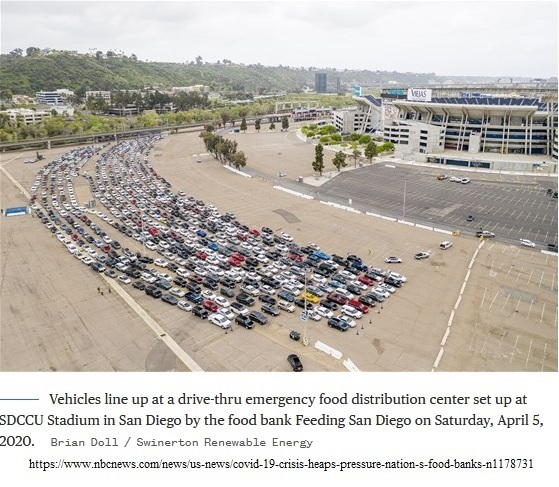
First, a thanks to Brian Doll for sharing this sad but powerful image of
vehicles lined up at SDCCU (San Diego County Credit Union) Stadium, vehicles
whose occupants are waiting in search of food provided graciously and
generously by the local food bank “Feeding San Diego.” This image is not
uncommon. Across the nation other communities are experiencing the same
problem, vehicles, often lined up for miles, patiently waiting for sustenance.
COVID-19 is a virus, but it’s also an enemy, an invisible and lethal enemy. As
the whole world knows, COVID-19 is humanity’s #1 enemy at this moment in human
history. Truly, we are at war.
COVID-19 struck quickly and powerfully in a blitzkrieg that has, like 9/11,
changed the world. It will be defeated but not until it has done more damage.
In its aftermath, we would be wise to reassess why so many countries around
the world, if not every country, was caught off-guard.
During this global pandemic of COVID-19 with its attendant turmoil and
concern, it is vital for all humanity—individuality and collectively—to remain
“balanced” and not allow the virus, or any other calamitous situation for that
matter, to dictate our disposition. When we lose our balance, we put ourselves
in a perilous situation. Uncomfortable? Of course, but Imperative to manage
and control. This is why “Balance is Primary” is a fundamental life principle,
not simply a martial arts precept.
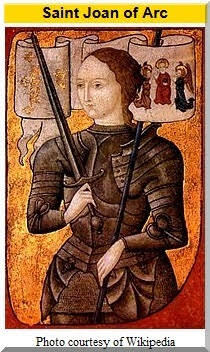
Joan of Arc is, arguably, the most famous female warrior in history. There are
others, of course, but her name is legend. You can read more about her life
here:
One of the stellar traits of great leaders is their positive and uplifting
spirit, a spirit that energizes and motivates others to rise to the occasion
and do great things. The following succinct and powerful quote from Joan of
Arc reflects such positivity.
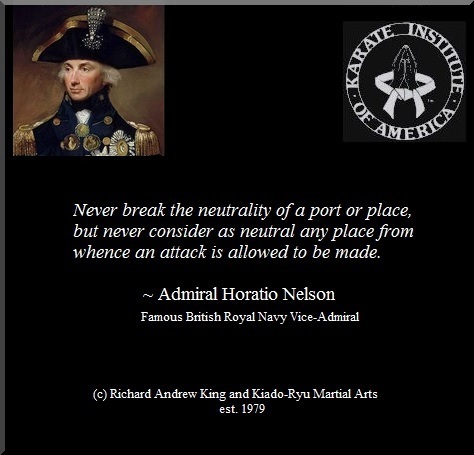
Horatio Nelson (1758-1805) is one of the most vaunted, heroic and
inspirational Royal Navy Commanders in British history.
Beset with health problems all his personal life, and besieged with battle
after battle in his military life, Lord Nelson remains the epitome of courage,
bravery and toughness. In honor of his contribution to Britain’s remarkable
legacy, a statue of Nelson adorns Trafalgar Square in London.
When Nelson stated,
Never break the neutrality of a port or place, but never consider as neutral
any place from whence an attack is allowed to be made.