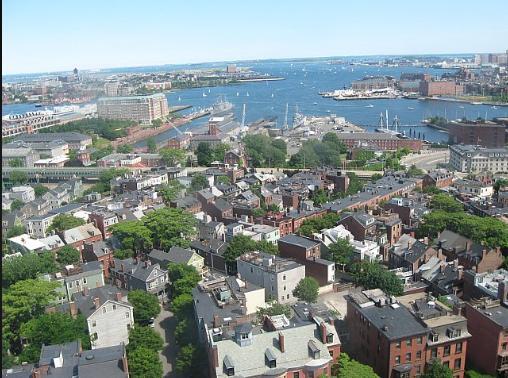
Looking down on inner
Boston Harbor,
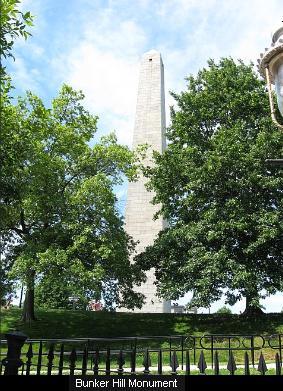
this photo was taken from the top of the
Bunker Hill Monument.
Notice the
USS Constitution
approximately 45 degrees to the upper right of the photo’s center. The top of
the monument offers a 360-degree view of the entire
Boston area. Such a beautifully visual
experience is well worth the 294-step climb to its zenith of 221 feet.
“Don’t fire until you see the whites of their eyes!”
It’s one of the most famous sayings originating from the American
Revolutionary War. This famous order was delivered by Colonel William Prescott
on June 17, 1775, to his colonial troops stationed just below the high ground
of Bunker Hill on Breed’s Hill, which was located lower and closer to the
water of Charleston Harbor so the attacking British troops could be engaged
earlier.
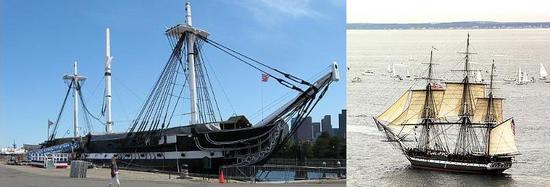
Her name conjures up famous wartime memories of the American Revolution. Known
as “Old Ironsides,” the
USS Constitution,
was named after the Constitution of the United States by General George
Washington. When in Boston, she’s a must-see for her historical significance.
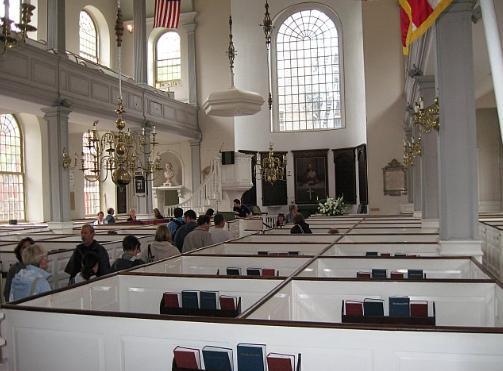
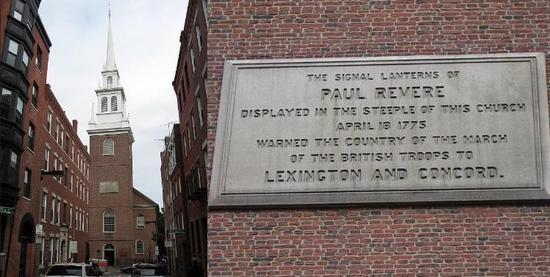
This is the interior of the
Old North Church
in Boston, Massachusetts. As we know from United States history, it was this
structure that is intrinsic to the legend of Paul Revere on April 18, 1775, in
which the signal lanterns were displayed, notifying fellow American freedom
fighters of the British march to
Lexington and Concord.
Listen my children and you shall hear
Of the midnight ride of Paul Revere,
On the eighteenth of April, in Seventy-five;
Hardly a man is now alive
Who remembers that famous day and year.
He said to his friend, “If the British march
By land or sea from the town to-night,
Hang a lantern aloft in the belfry arch
Of the North Church tower as a signal light,—
One if by land, and two if by sea;
And I on the opposite shore will be,
Ready to ride and spread the alarm
Through every Middlesex village and farm,
For the country folk to be up and to arm.”
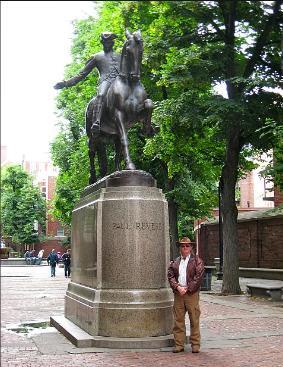
Paul Revere played a critical role in America’s Revolutionary War. This statue
of him is one of the many treasures along the Freedom Trail in Boston,
honoring him and the many patriots whose courage and vision birthed a free
nation.
You can read a
biography about Paul
Revere, his house, Midnight Ride, Silver Shop, Foundry, as well as the
Freedom Trail
in Boston.